
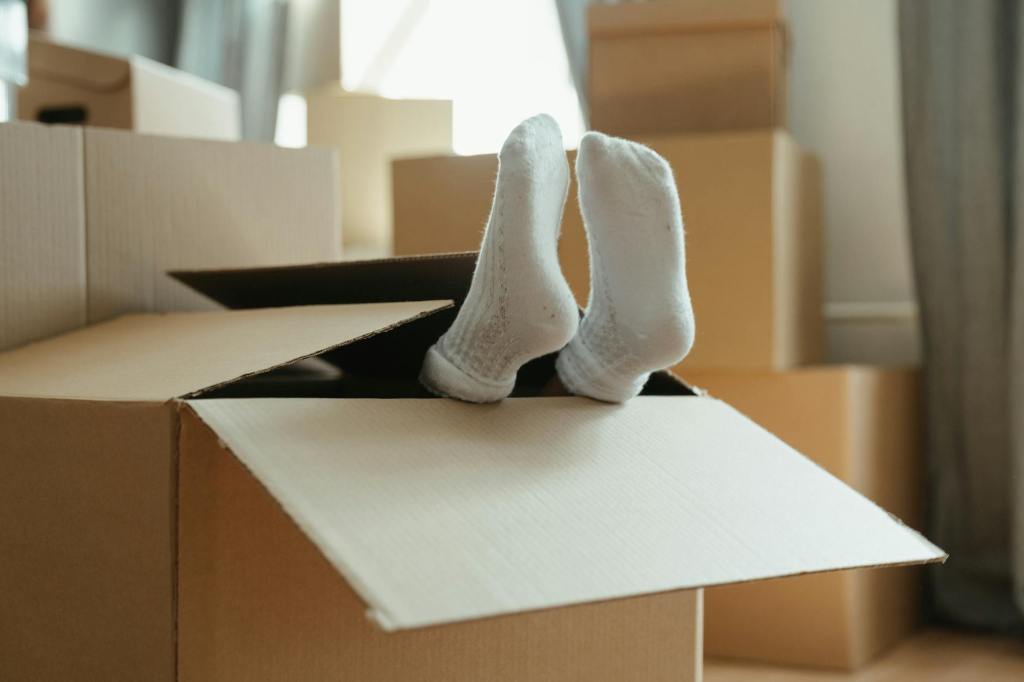
I spent the month of January packing up my apartment and moving to a house in a nearby town. I have a lot of experience moving due to various circumstances with family, college, the COVID pandemic, and my career.
However, this is my first time moving in order settle into a community and daily routine. This time I held a greater awareness of how my ADHD brain handled the process.
1) Packing things up
If you’ve never heard of time blindness and working memory, let me tell you about how I packed up my apartment.
I like to have a plan, otherwise I get anxiety about what I might forget to do. So, I imagined how many cardboard boxes I would need to pack up my apartment. Then, I thought if I packed one room per day that would take four full days (kitchen, bedroom, bathroom, living room).
I was so very wrong.
Working Memory
Working memory is information that the conscious brain is actively using. Think of the short-term memory as tabs open in a web browser and the working memory as the open tab you’re interacting with.
Approximately 3 out of 4 people with ADHD have deficits in working memory. Meaning that analyzing and applying information from your short-term memory is challenging.1

Not to say that people with ADHD can’t process and analyze information, but it does mean that I should not have estimated the number of cardboard boxes I needed off the top of my head.
My brain processes information better when I have it represented visually (I should have just looked at my stuff or written a list first). I learned my lesson; I opened every cabinet door to have a visual of what I did and did not pack up yet instead of tracking it in my head.
Time Blindness
I also vastly overestimated how much time I had to pack.
I did not factor how long I would unknowingly spend (*ahem,* this is time blindness) literally watching paint dry. I was fixated on matching the color and finish to cover the spackled holes.
Every Floridian landlord is obsessed with a different shade of beige. Did I think to just paint over the entire wall? Not until the day I turned in my keys.

*An example of FL beige. Is all the beige supposed to match the sand Florida has?
2) Unpacking (feels unending)
I set a date for a housewarming get-together before I unpacked. A) Because I moved into a house to invite people over more and B) To hold myself accountable for unpacking.
Getting Started: Task Paralysis
Task paralysis is pretty much when emotional or mental overwhelm makes it feel impossible to get something started (which can also lead to procrastination).2
Try to picture a sea of stacked boxes in a garage and imagine what kind of overwhelm that could create. Thankfully, I had help to get me through it. Having another person present to help you stay on track is known as “body doubling.”3

Yes, I started talking off topic to my body double. Yes, I still paced between rooms and forgot what I was doing repeatedly. But gosh darn it, my friend drove to my house to help me unpack; I had to unpack something.
Body doubling got the ball rolling, and the impending housewarming date forced my exhausted self to wrap up whatever else I could in my typical panicked frenzy.
Rebuilding routines
Being autistic, I crave routines. Being ADHD, I struggle building and maintaining them.
The first few two weeks of being in a new home was lawless. When my routines are disrupted, I can forget to do basic tasks like taking medication or cleaning.
Unpacking took time away from hobbies and chores. Plus, I had to recall the new or temporary locations of everything. Which drawer holds the utensils, which toiletry box has my hair ties and which room is the box of towels in again?
As I unpacked it got easier of course, but everything still feels pretty new to me. The learning curve can’t happen fast enough.
3) Enjoying the results

The first positive thing I noticed was that after moving, I built in new routines faster than I am able to change existing routines. I started reading more because the TV wasn’t hooked up for two weeks and I set up my bathroom to encourage a full skin care routine.
Both habits I’ve kept up even after fully unpacking.
The second positive is that I moved to an area I am familiar with and supports my lifestyle, so I get to return to some routines I previously lost like going to a morning yoga session and a local coffee shop that I enjoy.
Thirdly, I learned to lean on my partner and friends through the process instead of trying to do everything on my own. I couldn’t imagine getting this far without them.
References
- Michael J Kofler, Leah J Singh, Elia F Soto, Elizabeth SM Chan, Caroline E Miller, Sherelle L Harmon, and Jamie A Spiegel. “Working memory and short-term deficits in ADHD: A bifactor modeling approach,” Neuropsychology 34, no. 6 (2020): 686-698. https://doi.org/10.1037/neu0000641
- “ADHD paralysis is real: Here’s how to overcome it” Attention Deficit Disorder Association, published February 10th, 2025. https://add.org/adhd-paralysis/
- “What is ‘body doubling’ and can it help with ADHD?” Cleveland Clinic, published January 6th, 2025. https://health.clevelandclinic.org/body-doubling-for-adhd
 The Point of Divergence